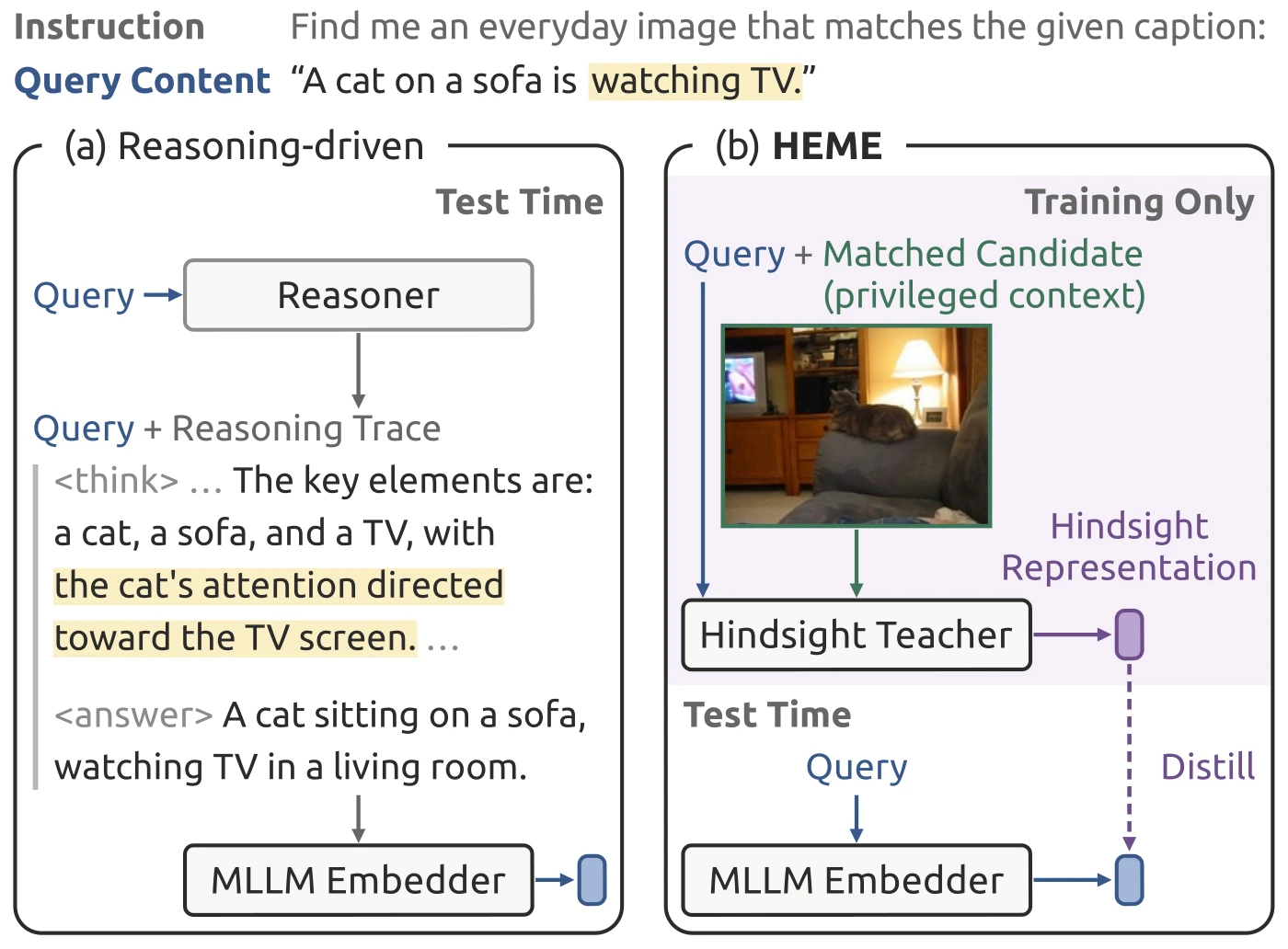
Figure 1. HEME uses the matched candidate to train a hindsight teacher. At test time, the student encodes queries and candidates independently in a single pass.Step through the example
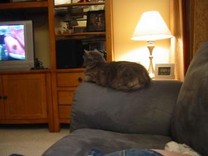
“A cat on a sofa is watching TV.”
The teacher sees both the caption and the matched image. Seeing the pair can help it connect “watching TV” to the direction of the cat’s gaze.
Abstract
Universal Multimodal Embedding (UME) models map heterogeneous multimodal inputs into a
shared embedding space, where pairwise similarity supports diverse downstream tasks. Recent
reasoning-driven UME approaches use intermediate reasoning to generate additional context
for embedding, but often incur extra computation at inference.
In this paper, we explore the matched candidate (i.e., the paired target) as an alternative
source of context, asking whether a model can “see the answer” during training and “learn to
embed” without it at inference. However, direct conditioning on this privileged context can
introduce candidate-specific information unavailable from the query alone or cause the
candidate-conditioned query representation to collapse toward the candidate embedding.
To address this, we introduce Hindsight-Enhanced Multimodal Embeddings (HEME),
which learns query-grounded hindsight representations from such candidate context. HEME
first trains a hindsight teacher with a hindsight attention mask, mismatched-candidate
conditioning, and query-token alignment to limit excessive reliance on the candidate. It
then freezes the teacher and distills its hindsight representation and similarity
distribution into a standalone student embedder. At inference, the student independently
encodes queries and candidates without candidate conditioning or the hindsight teacher.
Experiments on MMEB-V2 and the agent and text tasks of MMEB-V3 demonstrate the effectiveness
of HEME and show that it enables more efficient inference than explicit reasoning-driven
methods.
Method
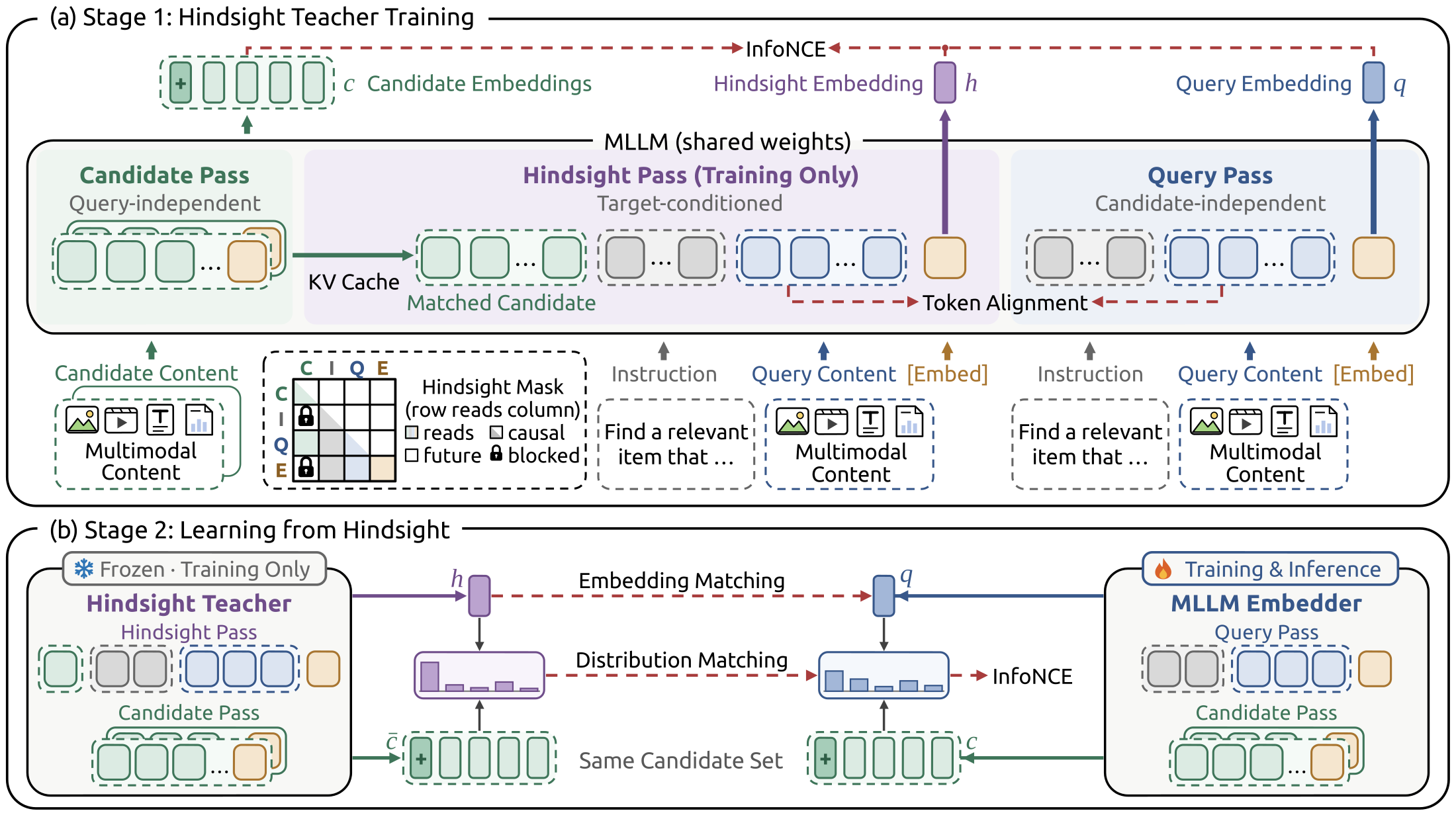
Figure 2. The teacher learns query-grounded hindsight representations. The student learns to match the frozen teacher’s embeddings and similarity distributions.
Hindsight teacher training.
The candidate and query passes encode their inputs independently, while the hindsight pass
conditions the query on its matched candidate by reusing the candidate KV cache. The hindsight
mask allows candidate context to influence the embedding only through query content tokens.
Together with mismatched-candidate conditioning and query-token alignment, this encourages the
hindsight representation to remain grounded in the query. The mismatched-candidate hindsight
pass is omitted from the figure for clarity.
Learning from hindsight.
The frozen hindsight teacher supervises a standalone student through embedding and similarity-
distribution matching, while the student is also trained with standard InfoNCE. At inference,
only the standalone student embedder is used.
Across 78 datasets, HEME scores 0.7 points higher overall than the best baseline shown at each model size. HEME also leads both groups on visual documents, scoring 77.3 at 2B and 80.6 at 7B.
Model
Image
Video
VisDoc
All
~2B model size
LaME
69.3
44.5
72.1
64.4
MMEmb-R1
70.0
50.6
68.0
65.0
VaME
69.5
46.3
74.4
65.7
HEME
69.7
45.3
77.3
66.4
~7B model size
LaME
73.0
50.8
75.9
68.8
MMEmb-R1
74.4
53.3
74.9
69.7
VaME
73.2
50.0
78.2
69.4
HEME
73.9
49.7
80.6
70.4
Image (36 datasets) and video (18) use Hit@1. Visual documents (24) use NDCG@5. All is the average over 78 datasets.
Inference efficiency
At the 2B scale, HEME encodes an input in 49 ms with zero sequential reasoning steps. Latency is the mean per input on a single NVIDIA H100 at batch size 1, using 10 matched pairs from each MMEB-V2 dataset.
Method
Reasoning
Steps
Latency (ms)
MMEB-V2
UME-R1
Explicit
408
10,903
60.1
RIME
Explicit
153
4,145
64.1
PLUME
Latent
8
295
61.6
LaME
Latent
0†
51
64.4
HEME
–
0
49
66.4
† LaME processes eight latent tokens in one forward pass.
MMEB-V3
HEME-7B scores 39.8 on agent tasks, the highest in the 7B comparison group. HEME achieves the best overall scores among the Qwen2-VL models at both scales.
Model
Backbone
Agent
Text
All
# Datasets
47
53
100
VLM2Vec-V2
Qwen2-VL-2B
28.7
24.5
26.5
E5-Omni†
Qwen2.5-Omni-3B
36.9
26.7
31.5
Omni-Embed-Nemotron†
Qwen2.5-Omni-3B
36.5
39.2
37.9
Qwen3-VL-Embedding†
Qwen3-VL-2B
39.3
39.2
39.2
HEME
Qwen2-VL-2B
36.9
34.4
35.6
VLM2Vec
Qwen2-VL-7B
19.7
22.2
21.0
LCO-Embedding-Omni†
Qwen2.5-Omni-7B
27.8
32.4
30.2
E5-Omni†
Qwen2.5-Omni-7B
36.7
26.9
31.5
GME†
Qwen2-VL-7B
35.6
37.1
36.4
Qwen3-VL-Embedding†
Qwen3-VL-8B
38.4
42.5
40.6
HEME
Qwen2-VL-7B
39.8
37.7
38.7
Agent tasks use Hit@1 and text tasks use NDCG@5. All is the average over 100 datasets. † Additional text-only training data.
Analysis
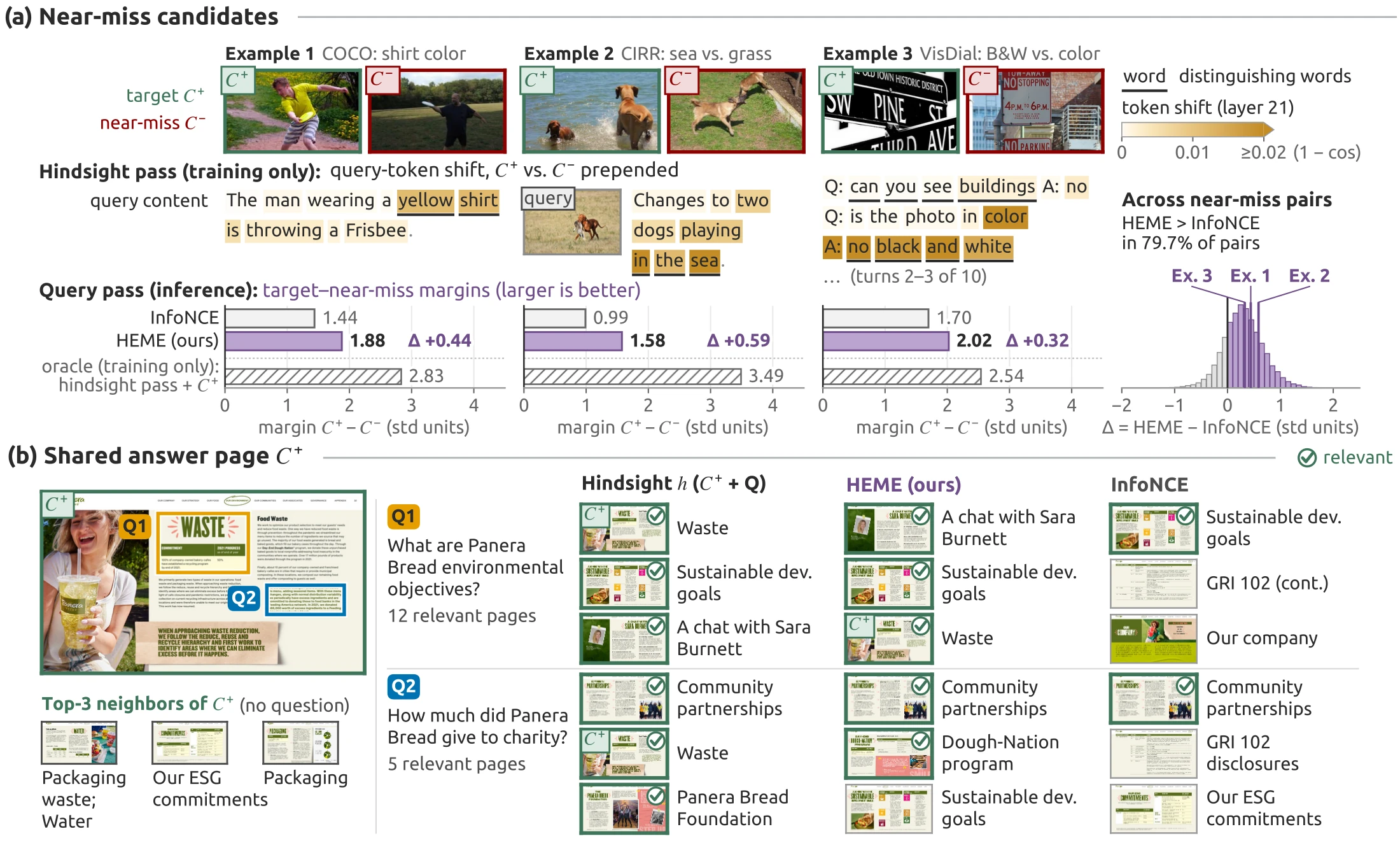
Figure 3. Query-token shifts, target margins and retrieval rankings for the examples in the paper.
Near-miss candidates (a). For a target C+ and a challenging near-miss C−, the hindsight pass shows larger query-token shifts on words that distinguish the two candidates; at inference, HEME exhibits stronger target–near-miss separation in the illustrated examples.
A shared answer page (b). For a single page C+ answering two different questions, conditioning on the same answer produces question-specific hindsight rankings; from the question alone, HEME exhibits corresponding retrieval behavior.
BibTeX
@misc{cho2026heme,
  author    = {Cho, Yoonki and Na, Youngju and Yang, Taegeun and Seo, Jinhwan and Yoon, Sung-Eui},
  title     = {See the Answer, Learn to Embed: Learning Universal Multimodal Embeddings from Hindsight},
  year      = {2026},
  eprint    = {2611.32439},
  archivePrefix = {arXiv},
  primaryClass = {cs.LG},
  url       = {https://arxiv.org/abs/2611.32439},
}
 Paper
 Code
 Model